Signs of Concealed Plumbing Leaks
Plumbing leaks rarely start as dramatic pipe bursts. More often, they begin as tiny pinhole sprays or slow fitting seeps hidden behind finished drywall, inside ceiling floor joists, or underneath tiled floors. Left undetected, slow moisture causes structural rot, drywall collapse, subfloor delamination, and microbial growth.
Common indicators requiring professional hidden water leak detection Islip include water utility bills doubling without increased usage, the spinning "leak indicator" triangle on your water meter turning when all taps are off, warm spots on tile or concrete slab floors, warped hardwood, or the persistent faint hiss of running water behind bathroom fixtures.
Ceiling Leaks & Multi-Unit Buildings
In multi-family residential complexes and two-story homes across Islip, Bay Shore, and Brentwood, a water leak from upstairs apartment Islip situations creates complex disputes between residents and property owners. Water appearing as a brownish ceiling ring or dripping from a light fixture may originate several feet away from where moisture is visible, as water travels along floor joists and electrical conduit before pooling at the lowest drywall seam.
Our methodical approach to ceiling leak repair Islip investigates upstairs shower pan seals, leaking toilet wax rings, tub overflow gaskets, and concealed drain risers to establish the true physical point of origin before opening ceilings.
Non-Invasive Diagnostic Methodologies
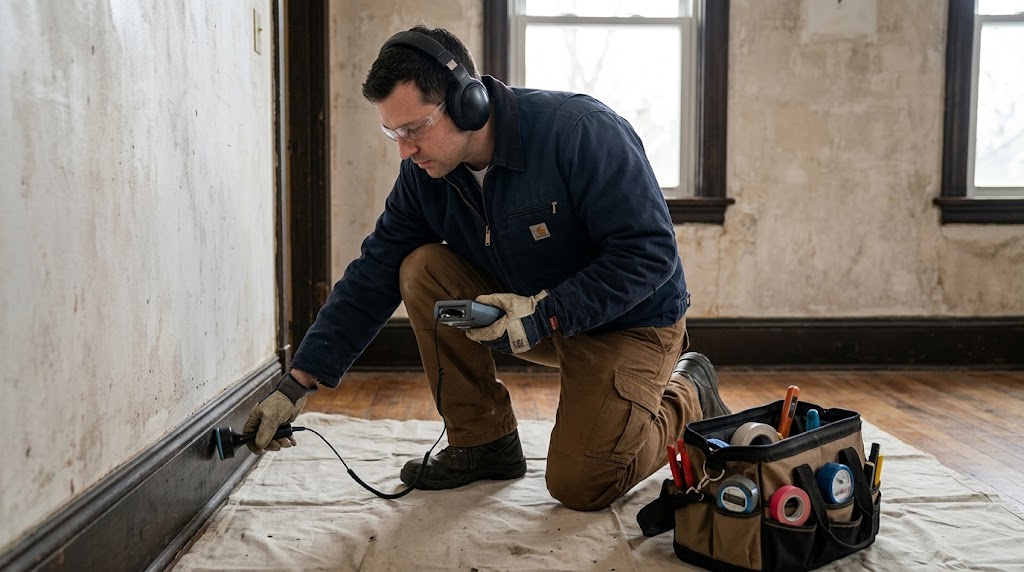
Rather than randomly tearing into finished plaster, tile, or drywall, our technicians deploy advanced non-destructive diagnostic tools:
- Acoustic Listening Sensors: Water under pressure (typically 45 to 65 PSI) emits distinct high-frequency vibrations as it escapes through tiny fissures. Ground microphones and listening discs amplify these sound frequencies, allowing technicians to pinpoint the exact coordinate behind wallboard.
- Infrared Thermal Imaging: Thermal cameras visualize subtle temperature differentials on wall surfaces. Hot water supply leaks show up as radiating thermal blooms, while cold water leaks register as distinct cool evaporation zones behind surfaces.
- High-Frequency Moisture Meters: Calibrated pinless moisture meters penetrate up to 1 inch through drywall, subflooring, and masonry to delineate wet structural boundaries without marring delicate paint.
- Pressure Decay Isolation Testing: By isolating individual supply branches and charging them with compressed air or regulated pressure gauges, we confirm whether a suspected drop occurs on the hot, cold, or drainage system.
Translating Findings into Targeted Repairs
When performing leak in wall detection Islip homeowners appreciate our commitment to minimal property disturbance. Once non-invasive tools pinpoint the defect's exact location, we make a neat, surgical inspection opening directly over the failed pipe segment.
From there, our technicians execute permanent copper soldering, PEX crimp replacements, or fitting repairs as detailed on our Pipe Leak Repair resource. If the leak involves a fixture shutoff or running toilet, explore our Toilet & Faucet Repair service, or return to our water heater repair Islip homepage for tank-related issues.
Suspect a Concealed Pipe Leak in Your Home?
Speak with an experienced plumbing technician to arrange electronic leak detection before damage spreads.
Frequently Asked Questions: Leak Detection
Technicians use calibrated acoustic listening sensors to detect pressurized water escaping through copper or PEX tubing, thermal imaging cameras to track sub-surface temperature differentials, and high-frequency moisture meters to map moisture boundaries before any wall opening is recommended.
Immediately place a bucket beneath the dripping area. If drywall is sagging under water weight, carefully puncture the center with a screwdriver to release water and relieve weight. Contact the upstairs resident or building management immediately to shut off local fixture stops, then call our team.
Non-invasive tools significantly narrow the leak's origin down to a tight perimeter. However, performing the physical pipe repair ultimately requires creating a neat, targeted access opening in the finished drywall, ceiling, or subfloor directly at the failure site.