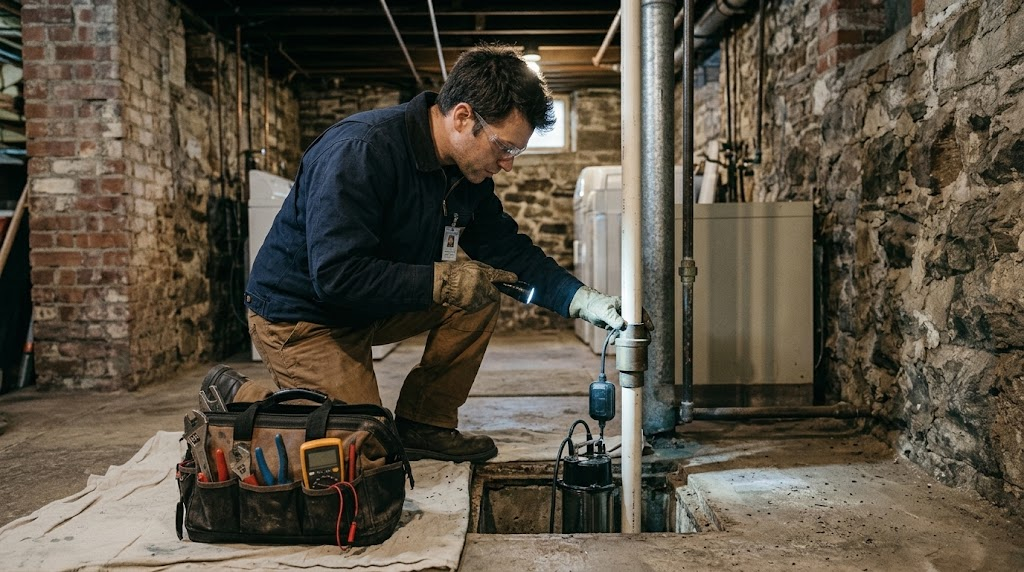
High Groundwater & South Shore Basement Flooding
The Town of Islip borders the Great South Bay, featuring low-elevation geography where the natural subterranean water table often sits mere feet below the surface. During prolonged rainfall events, astronomical high tides, or spring thaw, hydrostatic pressure mounts against foundation slab floors and perimeter walls.
When water infiltrates basements, essential appliances—such as boilers and units featured on our water heater repair Islip service—face immediate risk of submerged burners and electrical shorts. A well-maintained sump pump system actively collects this migrating groundwater through perimeter weeping tiles into a collection basin, pumping it safely away from the foundation before water levels can breach the floor slab.
Common Causes of Sump Pump Failure
When a basement floods despite having a pump installed, the cause is frequently a localized mechanical defect rather than motor burn-out:
- Failed or Tangled Float Switches: Mechanical vertical or tethered float switches can catch on the basin wall, pit wiring, or sediment debris, preventing the switch contacts from closing when water rises.
- Worn Check Valves: The inline rubber-flapper check valve prevents thousands of gallons of discharged water inside the vertical riser pipe from rushing back into the basin when the pump shuts down. A stuck valve creates endless short-cycling.
- Clogged Discharge Lines: Exterior discharge pipes can become obstructed by autumn leaves, mulch, dirt, or ice during freezing winter temperatures, creating backpressure that overloads the impeller.
- Impeller Cavitation & Debris: Stones, gravel, and sand entering unsealed basins can lodge between the vortex impeller blades, causing the motor to hum loudly without pumping water.
Heavy-Duty Sump Pump Installation & Upgrades
When existing equipment is undersized or compromised by years of mineral buildup, our technicians provide complete sump pump installation Islip homeowners rely on. We install professional-grade cast-iron submersible pumps with oil-cooled motors, vortex impellers capable of passing small solids, and heavy-duty basins with sealed gas-tight covers that keep radon, moisture, and odors out of your living space.
Battery Backup Systems & Outage Protection
The most severe South Shore storms that bring torrential rains are often the exact weather events that knock out overhead electrical utility lines. A standard 120V AC sump pump is completely useless during a regional blackout.
We install dual-pump protection systems featuring a primary pump coupled with an auxiliary 12-volt DC pump powered by a heavy-duty marine deep-cycle battery and smart microprocessor charger. If electrical power cuts out—or if the primary pump suffers a mechanical switch failure—the secondary backup pump automatically takes over, pumping continuously for hours and sounding an audible alarm to notify homeowners.
Groundwater vs. Sewage Backups: Backwater Valves
Homeowners must distinguish between clean groundwater intrusion and catastrophic sanitary sewer backups. Groundwater enters through foundation floors and is managed by sump basins. However, when municipal street sewers become overwhelmed by flash storms, raw municipal sewage can push backward through basement floor drains, utility sinks, and lower-level toilets.
To eliminate this hazard, we perform backwater valve installation Islip properties require. An open-flapper backwater valve is installed directly into the main building drain pipe beneath the concrete floor. It allows normal household wastewater to flow outward toward the municipal sewer or septic system, but automatically seals shut the instant wastewater pushes back, preventing contaminated sewer surcharges from flooding your basement.
Protect Your Basement From Water Intrusion
Schedule a comprehensive sump pump inspection, pit cleaning, or battery backup installation today.
Frequently Asked Questions: Sump Pumps
The most common failure points are grid electrical outages, a jammed or failed mechanical float switch, a broken check valve allowing discharged water to drain back into the pit, or an undersized pump overwhelmed by rapid groundwater influx.
Groundwater intrusion enters through foundation cracks, cove joints, or window wells as clear or silty water managed by a sump pit. A sewer backup occurs when municipal mains surcharge, pushing foul wastewater backwards through basement floor drains, which requires a backwater valve.
A battery backup unit operates on a dedicated deep-cycle marine battery and separate auxiliary pump. When severe weather knocks out grid power or the primary pump fails, the secondary pump activates automatically to keep basement water levels low.